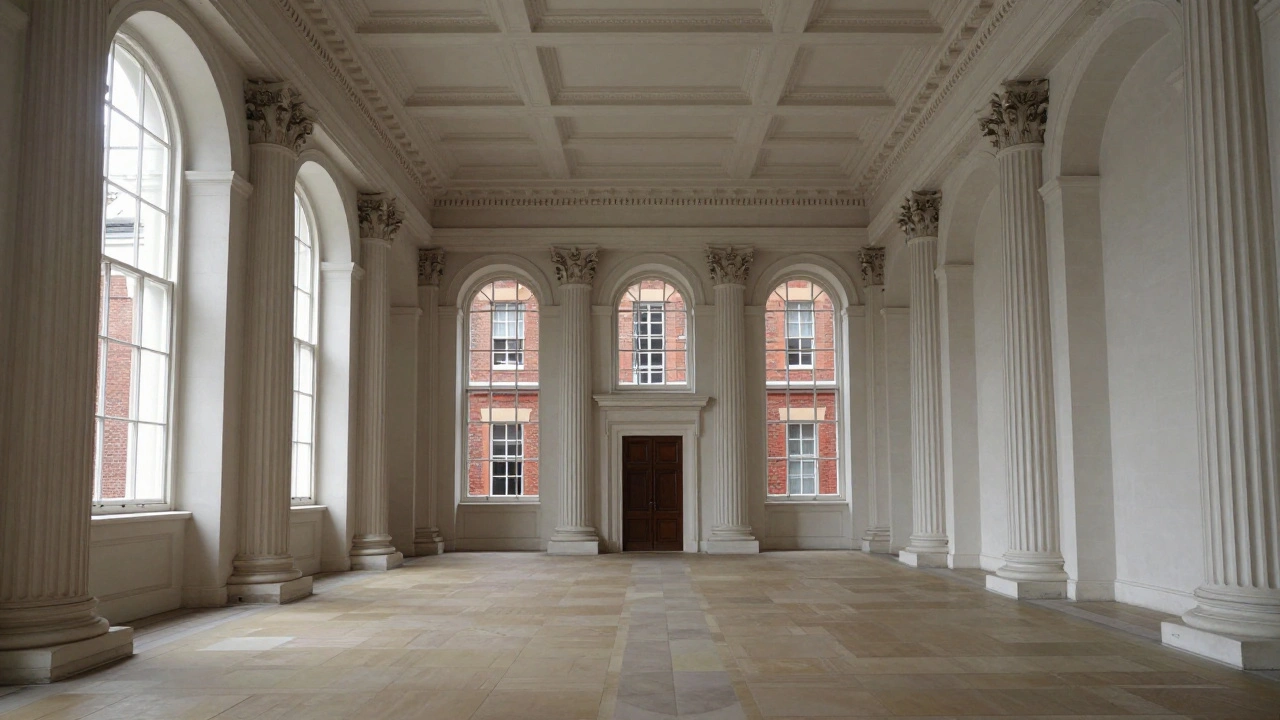
Walk into the Banqueting House in Whitehall, and you step out of modern London. The air feels heavier here, charged with the weight of royal ambition and tragic endings. This isn't just a surviving building; it is the only remaining part of the original Palace of Whitehall that burned down in 1698. But you aren't here for the bricks. You are here for the sky-or rather, the ceiling painted by Peter Paul Rubens, which tells the story of how King Charles I tried to paint himself as a god-like monarch, right before he lost his head.
This guide breaks down what makes this space unique, why the ceiling matters more than most art students realize, and how to see it without getting lost in the crowd. Whether you are a history buff or just wandering through Westminster, understanding the context turns a quick glance into a profound experience.
The Last Stand of Whitehall Palace
To appreciate the Banqueting House, you first need to understand what it survived. For centuries, the Palace of Whitehall was the primary residence of English monarchs. It was massive-larger than the Vatican-and served as the center of political power. Then, on January 4, 1698, a fire started in a kitchen chimney. Within hours, the palace was ash. Today, all that remains is this single block of red brick.
Designed by Inigo Jones, the architect who introduced classical architecture to England, the Banqueting House was revolutionary when it opened in 1622. Before Jones, English buildings were Gothic-dark, ornate, and vertical. Jones looked across the channel to Italy and brought back clean lines, symmetry, and light. The Banqueting House was the first true Palladian building in England. When you look at its facade, you are looking at the moment British architecture changed direction forever.
Inside, the space is starkly simple compared to the opulence of Versailles. There are no side rooms, no cluttered corridors. Just one vast hall designed for entertainment. This simplicity was intentional. It forced everyone’s eyes upward-to the ceiling.
Rubens’ Apology and Ambition
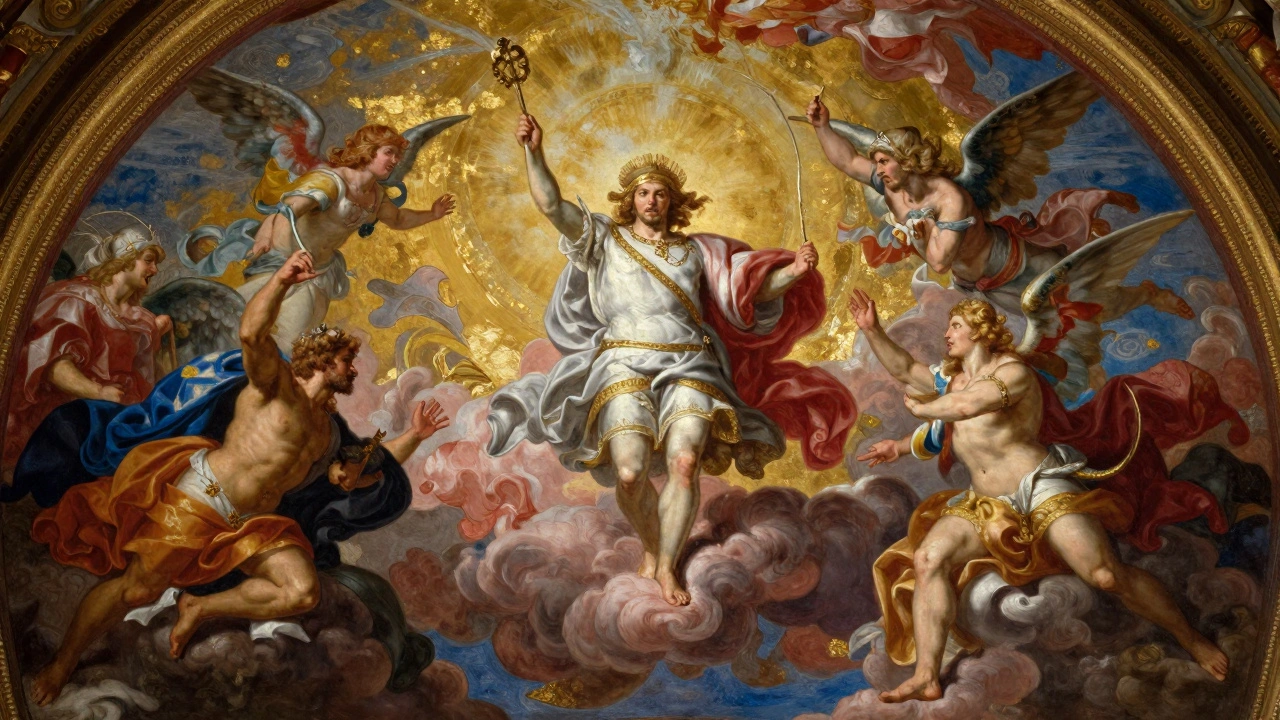
The ceiling is not just decoration; it is propaganda. Commissioned by Charles I and executed by the Flemish master Peter Paul Rubens between 1630 and 1634, the series of eleven panels forms a cohesive narrative called "The Apotheosis of James I." At first glance, the title suggests it honors Charles’s father, King James I. That is technically true, but politically, it is about Charles.
Rubens was a diplomat as well as a painter. He had negotiated peace treaties between England and Spain. His style was baroque-dynamic, emotional, and rich in color. In these panels, he uses mythological figures to flatter the Stuart dynasty. You will see Jupiter, Apollo, and Hercules interacting with royal portraits. The message is clear: the Stuarts are divinely ordained, wise, and powerful.
| Panel Title | Central Figure | Symbolic Meaning |
|---|---|---|
| Apotheosis of James I | King James I ascending | Divine right of kings; transition from mortal to immortal |
| The Union of Britain and Ireland | Britannia and Hibernia | Political unity under Stuart rule |
| Jupiter Crowning Britannia | Jupiter and Britannia | Gods endorsing the monarchy |
| Hercules Expelling Vices | Hercules | The king's strength against corruption |
Look closely at the central panel. James I is being lifted into heaven by angels. But notice the faces around him. They are idealized, calm, and distant. This was the image Charles wanted to project: stability, order, and divine connection. It was a desperate attempt to legitimize his rule during a time of growing religious and political tension.
The Irony of the Guillotine
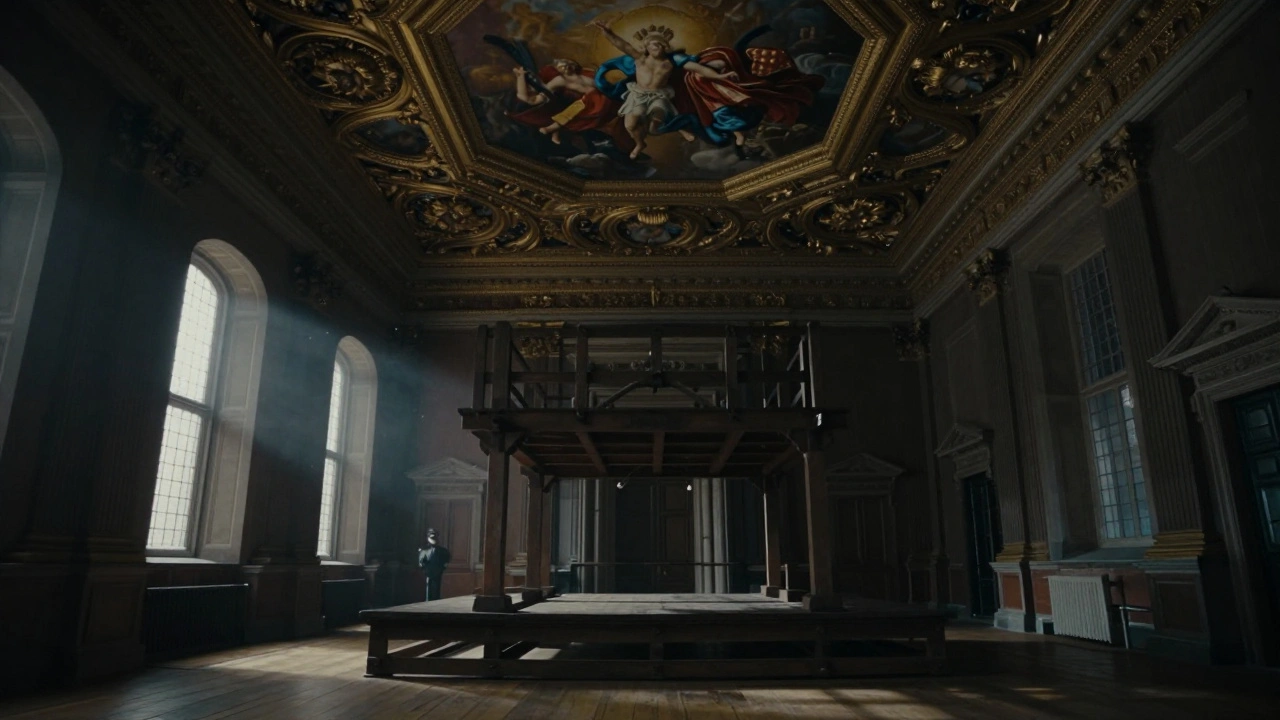
Here is where history takes a dark turn. The Banqueting House is famous not just for what was built there, but for what happened there. On January 30, 1649, a scaffold was erected in the exact center of the room, directly beneath Rubens’ glorified portrait of the Stuart dynasty. Charles I stood on that platform and was beheaded.
The irony is staggering. The man who commissioned the ceiling to prove his divine right was executed for treason against his own people. The ceiling, meant to immortalize his power, became the backdrop for his humiliation. After the Restoration in 1660, when Charles II returned to the throne, the scaffolding was removed, but the memory remained. The floorboards still bear the faint marks where the scaffold posts were fixed.
This duality defines the visitor experience. You are standing in a space of high art and low violence. The ceiling says "eternal glory," while the floor whispers "mortal failure." No other building in London captures this contrast so sharply.
Inigo Jones and the Architectural Revolution
We cannot talk about the Banqueting House without giving credit to Inigo Jones. Before Jones, English architects were largely masons working within medieval traditions. Jones traveled to Italy, studied Palladio, and returned with sketches that shocked his contemporaries. He didn’t just copy Italian styles; he adapted them to English materials and climate.
The Banqueting House is a masterpiece of proportion. The interior is divided into bays by pilasters-flat columns attached to the wall-that rise continuously from floor to ceiling. This creates a sense of height and grandeur without the need for heavy structural supports. The windows are tall and narrow, letting in soft northern light that illuminates the ceiling without causing glare.
Jones also introduced the concept of the "banqueting house" as a separate entity from the main palace. Previously, banquets were held in great halls that doubled as living quarters. Jones created a dedicated space for performance and display. This innovation influenced every subsequent palace design, including Buckingham Palace and even the Capitol Building in Washington D.C.
Visiting the Space Today
Today, the Banqueting House is managed by Historic Royal Palaces. It is open to the public year-round, though it closes for private events. If you plan to visit, keep these practical details in mind:
- Location: It sits at the end of Whitehall, near Horse Guards Parade. It is easily accessible via Embankment or Charing Cross stations.
- Tickets: Entry is included in the combined ticket for all Historic Royal Palaces sites. A standalone ticket costs around £15-£18 for adults.
- Guided Tours: Free guided tours run regularly. These are invaluable because guides point out details you would miss on your own, such as the hidden symbols in Rubens’ paintings.
- Photography: Photography is allowed, but flash is prohibited to protect the pigments. Tripods are generally not permitted due to space constraints.
When you enter, don’t rush. Spend at least ten minutes looking up. The ceiling is best viewed from the center of the room. Walk slowly toward the east end, then back to the west, observing how the light changes the appearance of the gold leaf. The gilding was applied using thin sheets of real gold, which explains why it still shines after four centuries.
If you are visiting in summer, go early in the morning. The crowds are thinner, and the natural light is softer. In winter, the artificial lighting highlights the depth of the brushwork, making the figures appear almost three-dimensional.
Preservation Challenges
Maintaining the Rubens ceiling is an ongoing challenge. The paintings were originally done on oak panels, which have warped slightly over time. Cracks have formed, and some pigments have faded. Conservation teams use advanced imaging techniques to monitor the condition of the wood and paint layers.
In recent years, there has been debate about whether to restore the ceiling to its original brightness. Some experts argue that the current muted tones add historical authenticity. Others believe that restoring the vibrant colors would reveal Rubens’ true intent. Currently, the approach is conservative: stabilize the existing state without altering the visual impact.
Another issue is pollution. London’s air contains particulates that settle on the surface of the paintings. Regular cleaning is necessary, but too much cleaning can damage the varnish. Conservators use specialized solvents and microfiber cloths to remove dirt without harming the underlying layers.
Why It Matters Now
In a city obsessed with newness, the Banqueting House offers a rare pause. It reminds us that power is temporary, but art endures. Charles I thought his reign would last forever. He was wrong. But Rubens’ ceiling still speaks to us, not because it flatters the king, but because it reveals the human desire for meaning and legacy.
For students of art, it is a textbook example of Baroque propaganda. For historians, it is a physical link to the English Civil War. For tourists, it is a quiet sanctuary in the heart of a busy city. Whatever your reason for visiting, take time to sit on the benches provided. Look up. Let the images sink in. You are not just seeing paint on wood. You are witnessing a conversation between artist and monarch, spanning four hundred years.
Is the Banqueting House free to enter?
No, entry requires a ticket. However, if you plan to visit multiple Historic Royal Palaces sites (like the Tower of London or Kensington Palace), buying a combined pass is more cost-effective. Children under 16 enter for free.
Can I take photos of the Rubens ceiling?
Yes, personal photography is allowed without flash. Commercial photography requires special permission. Avoid using tripods or selfie sticks as they obstruct other visitors.
Who painted the ceiling in the Banqueting House?
The ceiling was painted by Peter Paul Rubens, a Flemish Baroque artist. He worked on the project between 1630 and 1634 under commission from King Charles I.
What happened to Charles I in the Banqueting House?
Charles I was executed by beheading on January 30, 1649. A scaffold was erected in the center of the room, directly beneath the ceiling depicting his divine right to rule.
Is the Banqueting House wheelchair accessible?
Yes, the Banqueting House is fully accessible. There is level access throughout the building, and staff can assist visitors with mobility needs. Please inform the box office upon arrival.
How long does a typical visit take?
Most visitors spend 30 to 45 minutes inside. If you join a guided tour or read the informational panels, plan for at least an hour. The space is small, so there is no need to rush.