
Living in London isn’t cheap-but in 2025, it’s more unpredictable than ever. If you’re thinking about moving here, already renting, or just trying to figure out if your salary can stretch far enough, you’re not alone. Rent prices have shifted dramatically since 2023, and the neighborhoods that used to be "affordable" are now out of reach for many. This guide cuts through the noise with real numbers, updated trends, and honest advice for 2025.
How Much Does It Actually Cost to Rent in London Right Now?
In early 2025, the average monthly rent for a one-bedroom flat in London is £2,150. That’s up 8.7% from 2024 and nearly 22% since 2022. Two-bedrooms now average £2,800, and studios hover around £1,800. These aren’t outliers-they’re the new baseline.
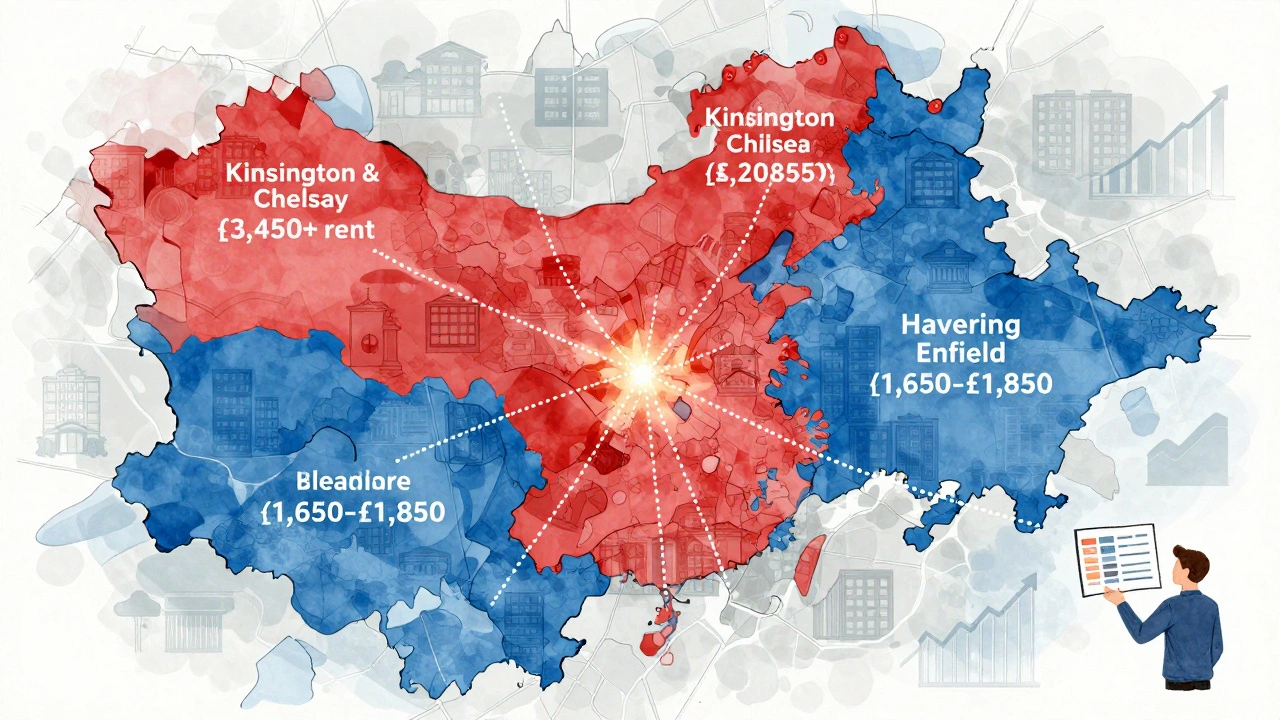
But averages lie. In prime areas like Kensington and Chelsea, a one-bedroom can easily hit £3,500. In contrast, outer boroughs like Barking & Dagenham or Havering still offer one-beds under £1,500. The gap between inner and outer London has widened, not narrowed.
Here’s what you’re actually paying in key areas (as of Q1 2025):
| Borough | Studio | One-Bedroom | Two-Bedroom |
|---|---|---|---|
| Kensington & Chelsea | £2,400 | £3,450 | £4,800 |
| Westminster | £2,200 | £3,100 | £4,300 |
| Camden | £1,950 | £2,750 | £3,700 |
| Islington | £1,850 | £2,600 | £3,500 |
| Wandsworth | £1,800 | £2,500 | £3,300 |
| Greenwich | £1,700 | £2,200 | £2,900 |
| Barking & Dagenham | £1,400 | £1,750 | £2,300 |
| Havering | £1,350 | £1,650 | £2,150 |
The data comes from the latest Rightmove and Zoopla reports, which now include 100% of private rentals-not just listings. That means the numbers are more accurate than ever.
Why Are Rents Still Rising in 2025?
It’s not just inflation. Three big forces are driving prices higher:
- Supply shortage: London has fewer than 1.2 million rental units available. Demand? Over 2.1 million households looking. That’s a 75% gap. New builds are slow, and many landlords pulled out after tax changes in 2023.
- International demand: London’s job market is still drawing talent from Europe, North America, and Asia. Even with higher visa costs, skilled workers in tech, healthcare, and finance are moving here-and they’re not looking for bargains.
- Short-term rentals: Platforms like Airbnb still have over 25,000 properties in London that used to be long-term rentals. The city cracked down in 2024, but many owners just reclassified them as "licensed co-living spaces," which aren’t regulated the same way.
There’s also a quiet shift: more people are renting longer. In 2019, the average tenancy lasted 18 months. In 2025, it’s 36 months. That means fewer turnover periods, less supply on the market, and landlords can afford to raise prices slowly but steadily.
Where Can You Still Find Value?
If you’re willing to move further out-or trade space for location-you can still find deals. Here are the top 5 boroughs with the best rent-to-value ratio in 2025:
- Barking & Dagenham: Under £1,750 for a one-bedroom, with a new Crossrail link cutting travel time to Canary Wharf to 22 minutes.
- Havering: Quiet, green, and still under £1,650. Good schools and low crime make it popular with young families.
- Enfield: North London’s hidden gem. One-beds average £1,850. The Northern Line extension means you’re in central London in 30 minutes.
- Kingston upon Thames: Not technically outer London, but it feels like it. Riverside living, £2,000 for a one-bedroom, and direct trains to Waterloo.
- London Borough of Sutton: Surprisingly affordable. One-beds at £1,900, with a fast train to Victoria.
These areas aren’t perfect. They’re farther from nightlife, have fewer cafes, and parking is tight. But if your job is remote or you can tolerate a 35-minute commute, they’re smarter choices than paying £3,000 for a shoebox in Zone 1.
What About Rent Control? Is Anything Being Done?
London doesn’t have rent control like Berlin or New York. But in 2024, the Mayor’s office rolled out a pilot program in five boroughs: Waltham Forest, Croydon, Lewisham, Newham, and Tower Hamlets. The rules are simple:
- Landlords can’t raise rent more than 3% per year on existing tenants.
- They must give six months’ notice before any increase.
- They must register all properties with the council.
It’s not a full freeze-but it’s slowing the spiral. Early data shows rent increases in these areas are 40% lower than in non-pilot boroughs. Landlords are still pushing for higher rates when a tenant leaves, but for those who stay, it’s a lifeline.
Don’t expect this to go citywide in 2025. The government says it’s still evaluating. But if the pilot works, it could become law by 2026.
How to Avoid Getting Ripped Off
Scams are up. Fake listings, pressure to pay deposits before viewings, landlords refusing to use deposit protection schemes-all of it’s more common now.
Here’s how to protect yourself:
- Always view in person. If a landlord says "I can’t show you because I’m abroad," walk away.
- Check the deposit protection. By law, your deposit must be in a government-approved scheme within 30 days. Ask for the certificate number. If they can’t provide it, don’t sign.
- Use only verified portals. Stick to Rightmove, Zoopla, or local council housing lists. Avoid Facebook groups and Telegram channels.
- Get everything in writing. Even small promises-like a new fridge or garden access-must be in the tenancy agreement.
Also: never pay cash. Always use bank transfer with a reference. Paper trails save lives.

What’s Next? The Outlook for 2026
Rents aren’t going down in 2025. But they might slow down. Analysts at Savills predict a 2-3% increase for 2026, down from 8-9% in recent years. Why? More supply is coming. Over 12,000 new rental units are scheduled to finish construction by late 2025. Most are in outer boroughs, aimed at mid-income workers.
There’s also a quiet revolution: co-living spaces are growing. Companies like Hoot and Common are opening 30+ new buildings in London this year. They offer private bedrooms with shared kitchens and living areas. Rent? Around £1,600-£1,900 for a 250 sq ft room with utilities and cleaning included. It’s not for everyone-but for young professionals, it’s a game-changer.
And if you’re looking to buy? Mortgage rates are finally dropping. The Bank of England cut rates twice in late 2024. First-time buyers are seeing more options. But prices are still 15% above pre-pandemic levels. So renting isn’t just a fallback-it’s becoming a long-term strategy.
Final Thoughts
London’s housing market isn’t broken. It’s just reshaped. The days of finding a £1,200 flat near the Tube are over. But if you’re smart about location, flexible on size, and know your rights, you can still live here without going broke.
Don’t chase the center. Look outward. Use the data. Protect yourself. And remember: rent isn’t just a cost-it’s your biggest monthly expense. Treat it like your most important financial decision.
What’s the cheapest area to rent in London in 2025?
The cheapest areas are Barking & Dagenham and Havering, where one-bedroom flats average £1,650-£1,750. These boroughs are far from central London, but new transport links (like Crossrail) make commuting easier than ever. They’re ideal if you work remotely or don’t mind a 35-40 minute train ride.
Is it better to rent or buy in London in 2025?
For most people, renting is still the smarter choice. The average London home costs £620,000. Even with a 10% deposit and a 3.2% mortgage rate, your monthly payment would be around £2,900-higher than the average rent for a two-bedroom. Plus, you’d be locked into a location with no flexibility. Renting gives you mobility, lower upfront costs, and no repair bills.
Can I negotiate rent in London?
Yes-but only if you’re signing a new lease. Landlords are more open to negotiation in slower months (January, August, and November). Offer to sign a 12-month lease instead of 6, pay rent upfront, or agree to take care of minor maintenance. Some landlords will drop £50-£100 off the monthly rent for those concessions.
Are there any government help schemes for renters in London?
There’s no direct rent subsidy for private tenants in 2025. But if you earn under £31,400 a year (London Living Wage threshold), you may qualify for Housing Benefit if you’re on Universal Credit. Also, some boroughs offer rent deposit loans or guarantees for first-time renters. Check with your local council-they often have hidden programs.
What’s the fastest-growing rental market in London?
Enfield and Sutton are seeing the fastest rent growth in 2025-up 11% and 9.5% respectively. Why? New transport investments (Northern Line extension and Victoria Line upgrades) are making them more attractive. They’re not cheap yet, but they’re catching up fast. If you’re looking for value now, these are the areas to watch.