
Leaving London for a day trip to Stonehenge and Salisbury used to mean renting a car, dealing with highway traffic, or paying way too much for a guided tour. But in 2026, it’s easier than ever to get there by train and shuttle-no driving, no stress, and you still get to stand in front of the stones and walk through one of England’s most breathtaking cathedrals. Here’s how to do it right.
Why Stonehenge and Salisbury Together?
Stonehenge isn’t just a pile of rocks. It’s a 5,000-year-old mystery built with precision that still puzzles scientists today. And Salisbury? It’s not just a town-it’s home to the best-preserved copy of the Magna Carta, a 13th-century cathedral with the tallest spire in England, and a quiet charm that feels worlds away from London’s rush.
Most people visit Stonehenge alone. But if you add Salisbury, you get history, architecture, and a real sense of place. You’re not just seeing a monument-you’re walking through the landscape where these structures were built, lived in, and worshipped in for centuries.
How to Get There: The Train + Shuttle Route
The smartest way to get from London to Stonehenge and Salisbury in 2026 is to take a train to Salisbury first, then hop on a shuttle to Stonehenge. It’s faster, cheaper, and more reliable than trying to drive or book a full-day tour.
Step 1: Take the train from London Waterloo to Salisbury
- Trains leave hourly from 6:15 a.m. to 9:30 p.m.
- Travel time: 1 hour 30 minutes to 1 hour 50 minutes
- Ticket price: £28-£45 one-way, depending on when you book
- Book via South Western Railway (swr.co.uk) or Trainline app
There’s no need to buy a fancy first-class ticket. Standard class is fine. The trains are clean, quiet, and have free Wi-Fi and power outlets. You’ll pass through countryside that looks like it’s from a Jane Austen novel-rolling hills, thatched cottages, and sheep grazing by the tracks.
Step 2: Walk to the Salisbury Shuttle Stop
- Salisbury train station is a 5-minute walk from the city center
- The shuttle to Stonehenge departs from the Salisbury Bus Station, right outside the train station
- Shuttle runs every 30 minutes from 8:00 a.m. to 5:30 p.m. (daily, year-round)
- Cost: £12 round-trip, £8 one-way
- Travel time: 25 minutes to Stonehenge Visitor Centre
The shuttle is run by National Trust and is the only direct public transport option to Stonehenge. No other buses go there. It’s not a tour bus-it’s a simple, no-frills shuttle that drops you at the visitor center. You’ll get a map, a ticket, and a clear path to the stones.
What to Do at Stonehenge
Arriving at the Stonehenge Visitor Centre? Don’t rush to the stones. The center has a museum that’s just as important as the site itself.
- See the original tools, bones, and pottery from the builders
- Watch the 360-degree immersive film that shows how the stones were moved-yes, they used sledges, ropes, and hundreds of people
- Grab a coffee or sandwich-the café has local cheeses and sourdough bread
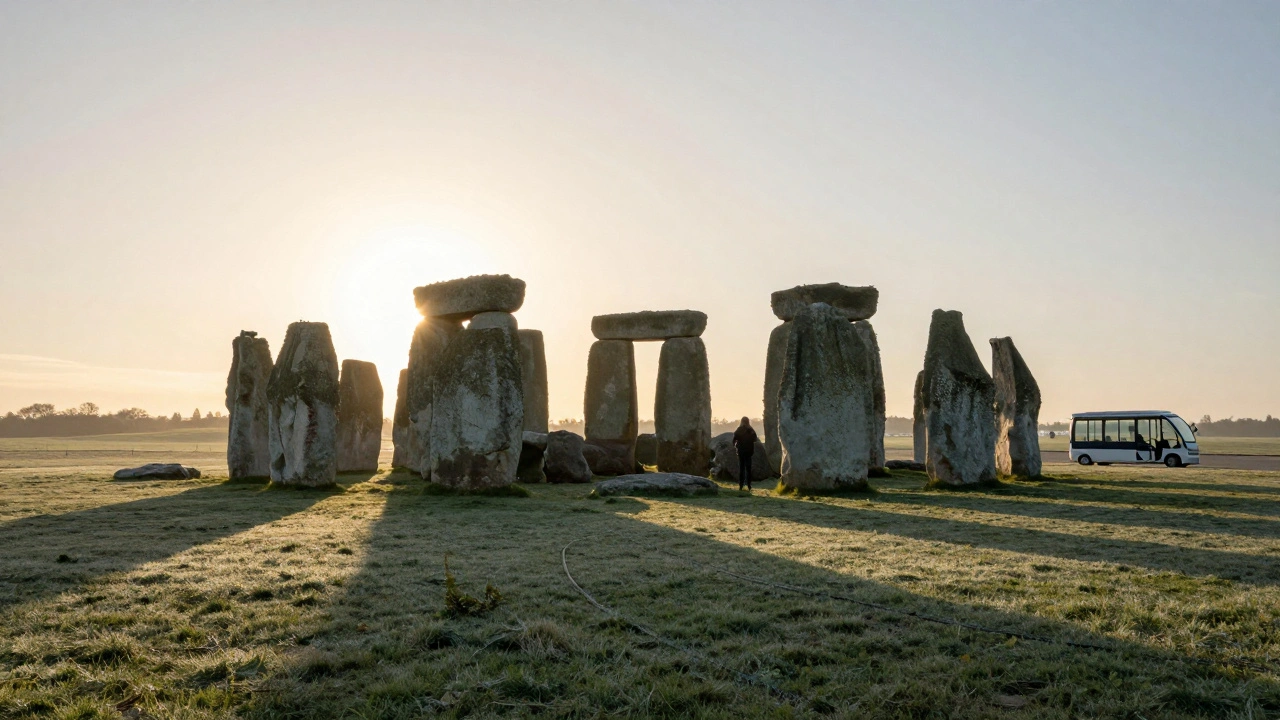
After the museum, you’ll take a free electric shuttle to the stones (a 10-minute ride). You’re allowed to walk within 10 meters of the circle. No touching. No climbing. But you can stand right where ancient people stood.
Pro tip: Go early. The first shuttle leaves at 8:00 a.m. and you’ll have the stones almost to yourself. By 11 a.m., tour buses start arriving. If you’re there at sunrise, you’ll see the sun rise exactly over the Heel Stone-a phenomenon that’s been happening for 5,000 years.
Back to Salisbury: The Cathedral and More
After Stonehenge, you’ll return to Salisbury on the same shuttle. You have until 6 p.m. to explore the town. Don’t miss the cathedral.
- Salisbury Cathedral is 800 years old and still in use. Its spire is 123 meters tall-the tallest in the UK.
- The Magna Carta is displayed in the Chapter House. It’s one of only four surviving originals. You can see the ink, the wax seal, and the tiny scribbles from medieval scribes.
- The cloisters are quiet, shaded, and perfect for sitting with a book. Locals come here to read lunchtime.
- Entry: £16 for adults, free for under-16s. Includes access to the cloisters, chapter house, and tower climb (extra £10).
Want to climb the tower? It’s 330 steps, narrow, and steep. But the view over the city and the surrounding Wiltshire hills? Worth every ache. The cathedral also has a medieval treasury with silver chalices and embroidered vestments.
Walk around the cathedral close. The houses here are still built from the same 13th-century stone. One of them is a tea shop called The Cloister Tea Room-try the scone with clotted cream. It’s the best in the county.
What to Pack
This isn’t a city day trip. You’ll be walking on grass, stone, and uneven paths.
- Sturdy shoes-no flip-flops
- Waterproof jacket-even in March, rain can come fast
- Warm layers-wind sweeps across the Salisbury Plain
- Small backpack (no large bags allowed at Stonehenge)
- Snacks and a thermos-food options are limited at Stonehenge
- Phone charger-cell service is spotty near the stones
You won’t need cash in the UK anymore. Most places take contactless. But keep a £5 note for the public toilets at the cathedral-yes, they still charge.

What Not to Do
- Don’t try to drive to Stonehenge yourself-parking is £10, and the roads are narrow
- Don’t skip the shuttle-there’s no public bus from Salisbury to the stones
- Don’t rush the cathedral-spend at least 90 minutes there
- Don’t forget the return train-last train from Salisbury is 11:15 p.m.
Is This Trip Worth It?
Yes. In 2026, this day trip costs under £70 (train + shuttle + cathedral entry) and takes less than 2 hours each way. You’ll see two of England’s most important historical sites without hiring a guide, waiting in line for a tour bus, or renting a car.
It’s the kind of trip that sticks with you. Standing in front of Stonehenge, you feel time collapse. In Salisbury, you see how those ancient rituals evolved into the churches, laws, and communities we still live in today.
If you’ve only seen London’s museums, you haven’t seen England. This trip shows you the soul of the country.
Can I visit Stonehenge and Salisbury in one day?
Yes, absolutely. With the train and shuttle system, you can leave London by 7 a.m. and be back by 11:30 p.m. Most people spend 3-4 hours at Stonehenge and 2-3 hours at Salisbury Cathedral. You’ll have time for lunch, a quick walk around town, and even a tea break.
Do I need to book Stonehenge tickets in advance?
Yes. Stonehenge limits daily visitors to protect the site. Buy tickets online through the National Trust website before you leave London. You’ll get a timed entry slot. Walk-up tickets are rarely available.
Is the shuttle to Stonehenge wheelchair accessible?
Yes. The shuttle buses are wheelchair accessible, and the visitor center has ramps, elevators, and accessible restrooms. The path to the stones is paved, but the final stretch is grass and gravel. Wheelchair users can get very close to the circle. Staff are trained to help.
Can I bring my dog to Stonehenge or Salisbury Cathedral?
Dogs are allowed on leads at Stonehenge and in the cathedral grounds, but not inside the visitor center or cathedral building. Service animals are welcome everywhere. Bring water and a towel-the grass gets muddy.
What’s the best time of year to go?
Spring (March-May) and early autumn (September-October) are ideal. The weather is mild, the crowds are smaller, and the grass is green. Summer is busy, and winter can be wet and windy. Don’t go in December unless you want to see the stones covered in snow-some people do, but it’s not for everyone.