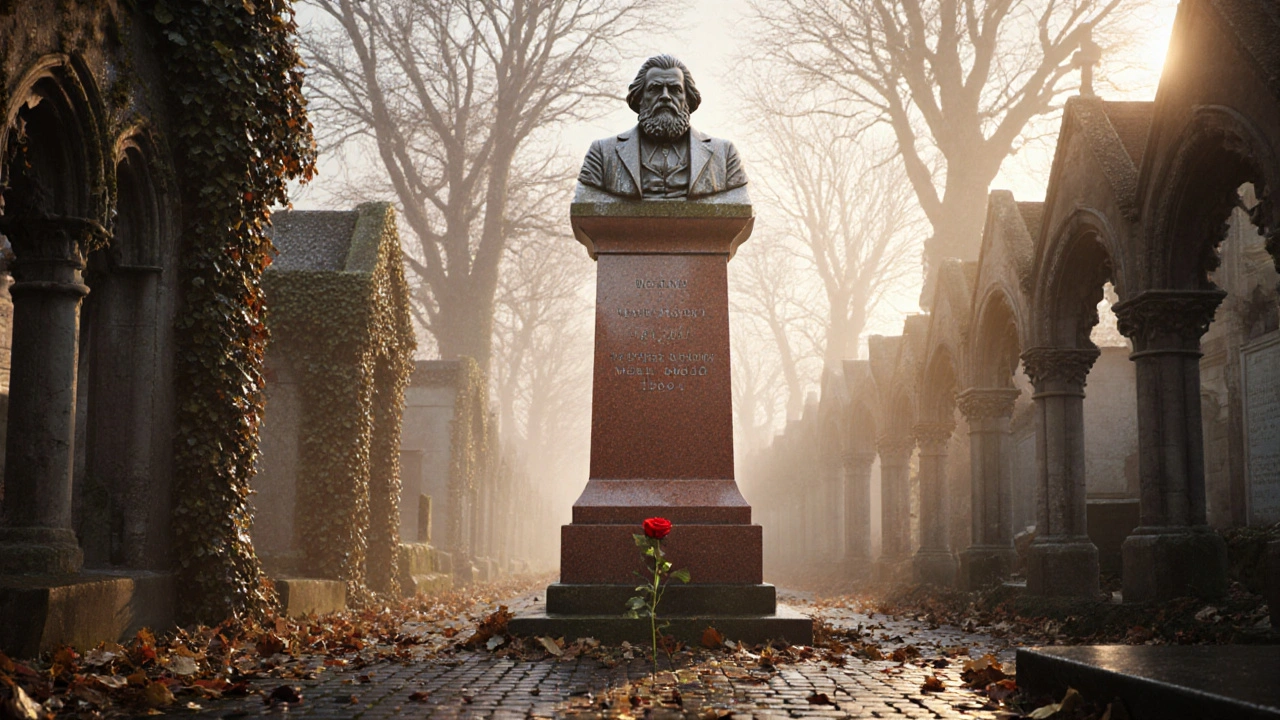
Karl Marx Grave
When you stand before the Karl Marx grave, the imposing monument in Highgate Cemetery where the philosopher and economist was laid to rest in 1883. Also known as Marx’s tomb, it’s not just a burial site—it’s a pilgrimage for those who study power, labor, and inequality. You won’t find a quiet, forgotten stone. This is a towering, bronze-browed monument with a giant head of Marx staring out, surrounded by quotes from The Communist Manifesto. It’s one of the most visited graves in London—not because people come to mourn, but because they come to remember.
Highgate Cemetery itself is a quiet, overgrown wonder. Unlike the neat rows of Westminster Abbey, this place feels alive with history. The east side, where Marx rests, was built for the middle class in the 1830s. His grave wasn’t always this grand. He was originally buried in a simple plot. It wasn’t until 1954, when the British Communist Party raised funds, that the current monument was erected. The statue? Designed by Laurence Bradshaw, a British artist and communist. The inscriptions? Not just political—they’re poetic. "Workers of all lands unite" isn’t just a slogan. It’s a demand that still echoes in protests, strikes, and debates about wages today.
People come here from all over the world: students, activists, tourists, skeptics. Some leave flowers. Others leave books. A few even leave coins—though no one’s sure why. The grave sits near other notable figures, like George Eliot’s partner George Henry Lewes, but Marx’s spot draws the most attention. Why? Because his ideas didn’t die with him. They shaped revolutions, governments, and entire economic systems. Even if you disagree with him, you can’t ignore him. His name is on every textbook, every protest sign, every conversation about inequality.
What’s surprising is how few people know the full story. He wasn’t buried here because he was British—he was a German exile who lived most of his life in London. He died poor, in a rented house in Soho. His friend Engels paid for the funeral. The grave’s grandeur came decades later, built by people who believed in what he stood for. Today, it’s maintained by the Marx Memorial Library, a small but active group that still holds lectures here.
There’s no entry fee. No timed tickets. Just a short walk from Archway Tube station, through the iron gates, down the winding path, past the ivy and the old tombstones. You don’t need to be a scholar to feel something here. The weight of his ideas, the scale of the monument, the quiet hum of visitors—it all adds up. This isn’t just a tourist stop. It’s a reminder that ideas can outlive empires.
Below, you’ll find posts that touch on related moments in London’s history—from literary walks where Dickens wrote about poverty, to museums that display the tools of labor movements, to how modern debates about wages and automation still echo Marx’s warnings. You won’t find a single article that says "Marx was right" or "Marx was wrong." But you will find real stories from people who live with the consequences of his thinking. And that’s more valuable than any textbook.