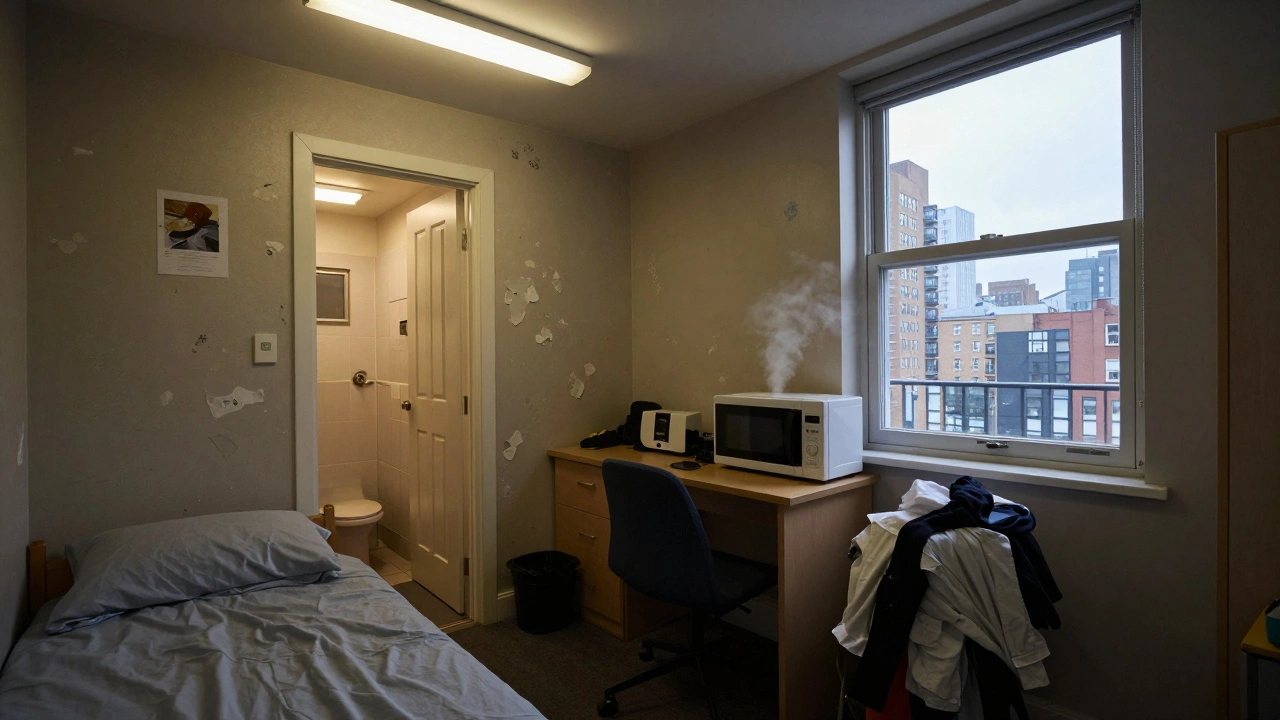
Living in a university hall of residence in London isn’t just about having a roof over your head-it’s about finding a place that fits your budget, your schedule, and your sanity. With rent prices climbing and space at a premium, knowing what to expect before you sign a contract can save you thousands and a lot of stress. This isn’t a brochure. This is what it’s really like.
What You Actually Pay
Don’t let the university website fool you. A room in a London hall doesn’t cost £800 a month. It costs £1,200. Or more. The cheapest options-usually shared bathrooms, no en-suite, and smaller rooms-start around £1,100 in zones 2-3. If you want an en-suite, a decent view, or a newer building? You’re looking at £1,500-£1,800. And that’s just rent. Utilities? Usually included. But don’t count on free Wi-Fi upgrades or laundry. Most halls charge £3-£5 per wash cycle.
For comparison: a one-bedroom flat in Zone 3 might cost £1,600, but you’d have to pay council tax, gas, electricity, and internet separately. Halls bundle it all. That’s the trade-off. You pay more upfront, but you don’t get hit with surprise bills.
Room Types You’ll Actually See
There are three main types of rooms in London halls, and they’re not what you think.
- Standard shared: One bed, one desk, one wardrobe. Shared bathroom with 4-8 others. You’ll know your neighbors’ schedules by the smell of their microwave meals. This is the most common-and cheapest-option. Found in older halls like UCL Student Housing a university-managed residence offering standard shared rooms for students in central London or King’s College London a major university in central London with multiple student residence options.
- En-suite: Private bathroom. Still shared kitchen. You’ll pay 30-50% more. Worth it if you hate waiting for showers after midnight. Popular at Imperial College London a public research university in London known for science and engineering, with modern student residences and London School of Economics a public university in London specializing in social sciences, offering premium student accommodation.
- Studio: Private bathroom, kitchenette. Rare. Only in newer builds like Goldsmiths, University of London a public university in southeast London with modern student housing featuring studio apartments or University of the Arts London a public university in London offering specialized student accommodation for arts students. Costs £1,800+. Only for those with serious savings or family support.
Where the Real Trade-Offs Happen
Location matters, but not like you think. A hall right on campus sounds ideal-until you realize you’re 45 minutes from the nearest Tube station. Queen Mary University of London a public research university in East London with student residences in the Mile End area has great halls, but you’ll need a weekly Oyster card just to get to lectures. Meanwhile, City, University of London a public university in central London with student housing close to the financial district sits in Zone 1. You can walk to class. The rent? £1,600. But you’re stuck in a building with 300 other students and zero green space.
Some halls are built like hotels. Others feel like dorms from the 1980s. Check photos from current students on Reddit or Instagram. Don’t trust the university’s glossy brochures. One student at University of London a federal university system in London with multiple member institutions and associated student accommodations told me her room had mold on the ceiling. The hall manager said, “It’s just condensation.” She moved out after two weeks.

Life Inside the Hall
There’s no privacy. Ever. You’ll hear your neighbor’s Zoom calls. You’ll smell their curry. You’ll get woken up by someone’s 3 a.m. Netflix binge. That’s the price of community.
But here’s the upside: you’ll make friends fast. Shared kitchens become hangouts. Common rooms turn into study groups. At SOAS University of London a public university in London focused on Asia, Africa, and the Middle East, with a diverse student body and active residence life, students organize weekly potlucks. At University College London a public research university in central London with a large student population and extensive residence network, there’s a 24-hour study lounge with free coffee. These aren’t perks. They’re lifelines.
Security? Most halls have key fobs, CCTV, and night porters. You’ll still get random visitors knocking on your door. Always lock it. Always. I knew a student who left her door open because she trusted the system. Her laptop was gone in 20 minutes.
The Rules You Can’t Ignore
Halls have rules. Some are silly. Some are serious.
- No parties after 11 p.m. (they mean it. Security shows up with a clipboard.)
- No cooking in bedrooms (yes, they check. One student got fined £150 for a toaster in her room.)
- No guests staying more than 3 nights in a row.
- You can’t sublet. Ever. Even to a friend.
- Damage fees are brutal. A broken lamp? £50. A scratched floor? £200. A hole in the wall? You’ll be paying for a new room.
Read the contract. Seriously. One student signed without reading the fine print and found out she was responsible for £300 in cleaning fees because her roommate left a dirty pan. The university didn’t care. She had to pay.

What No One Tells You
Most halls don’t have air conditioning. London summers hit 30°C. You’ll sweat through exams. Bring a fan. Buy one before you arrive-it’s £30 on Amazon. At the hall shop? £60.
Laundry isn’t free. And it’s not always available. At King’s College London a major university in central London with multiple student residence options, the machines break down weekly. You’ll learn to do laundry on weekends, early. Or you’ll end up with a pile of stinking clothes.
Food delivery? You’ll use it. A lot. But delivery drivers can’t enter halls after 10 p.m. You’ll have to meet them at the gate. Or wait till morning. One student told me she missed her 1 a.m. kebab because the gate was locked. She cried. Then ordered a sandwich.
When You Should Skip the Hall
Not everyone should live in halls. If you’re:
- Over 22 and want quiet
- Working part-time and need flexible hours
- Have dietary restrictions or medical needs
- Need to study late and can’t tolerate noise
Then consider a private student apartment. Companies like Unite Students a private student accommodation provider in London with modern, purpose-built student housing or Student Housing Company a private provider offering student residences across London with flexible leases and amenities offer quieter buildings, 24/7 access, and fewer rules. Rent is higher, but you get more control.
And if you’re in London for more than a year? Move out after your first term. Halls are great for settling in. Not for staying.
Final Advice
Apply early. Seriously. The best rooms go in January. If you wait till June, you’ll get the room next to the boiler room. Or the one with no window. Or the one that’s 20 minutes from campus.
Don’t pick based on Instagram. Pick based on:
- Distance to your department
- Number of people sharing a bathroom
- Laundry availability on weekdays
- Whether the building has a quiet zone
- What the current students say on Reddit
And if you’re nervous? Talk to someone who’s already there. Universities have student ambassadors. Email them. Ask for a video tour. Most will send one. I did. It saved me £200 a month.