Walk through the City of London or stroll along the South Bank, and you’ll notice something strange. The skyline isn’t just a sea of glass towers from the 2000s or brutalist concrete blocks from the 1970s. There’s a colorful, chaotic, and often controversial layer of buildings that popped up between 1980 and 1995. This is Postmodern Architecture, a movement that rejected the strict rules of Modernism by adding ornament, color, and historical references to new buildings. It was loud, it was playful, and for many people, it was the savior of urban life in Britain.
London is one of the best places in the world to see this style because the city never fully embraced the cold minimalism of its predecessors. Instead, architects like Norman Foster, Richard Rogers, and local firms experimented with form and function in ways that still spark heated debates today. Is it kitsch? Is it genius? Or is it simply the most honest expression of late-20th-century capitalism? Let’s look at the highlights and the fights that defined this era.
The Rejection of "Less is More"
To understand Postmodernism, you have to understand what it was fighting against. Modernism, an architectural philosophy dominant from the 1920s to the 1970s that emphasized simplicity, functionality, and the absence of decoration, believed that ornament was a crime. Architects like Le Corbusier wanted buildings to be "machines for living." In London, this translated into stark, windowless concrete slabs and sterile office blocks that felt disconnected from the historic streets around them.
By the late 1970s, the public was tired. The housing estates were crumbling, and the corporate offices felt soulless. Postmodernism arrived as a reaction. It said, "Why not use columns? Why not add a pediment? Why not make a building look like it belongs in the neighborhood, even if it’s made of steel and glass?" This shift wasn't just aesthetic; it was social. It invited people back into the street level by creating facades that engaged with the viewer rather than ignoring them.
Iconic Highlights You Can See Today
You don’t need to dig through archives to find these buildings. They are standing right there, dominating skylines and shaping neighborhoods. Here are three major examples that define the London Postmodern landscape:
- Canary Wharf (The Tower Block): While often grouped with later skyscrapers, the early developments in Canary Wharf, particularly the original One Canada Square designed by César Pelli, marked the shift toward high-rise commercial hubs. However, the surrounding podiums and retail fronts often utilized postmodern detailing to soften the massive scale. The area represents the financial boom of the 1980s, where architecture became a symbol of global capital.
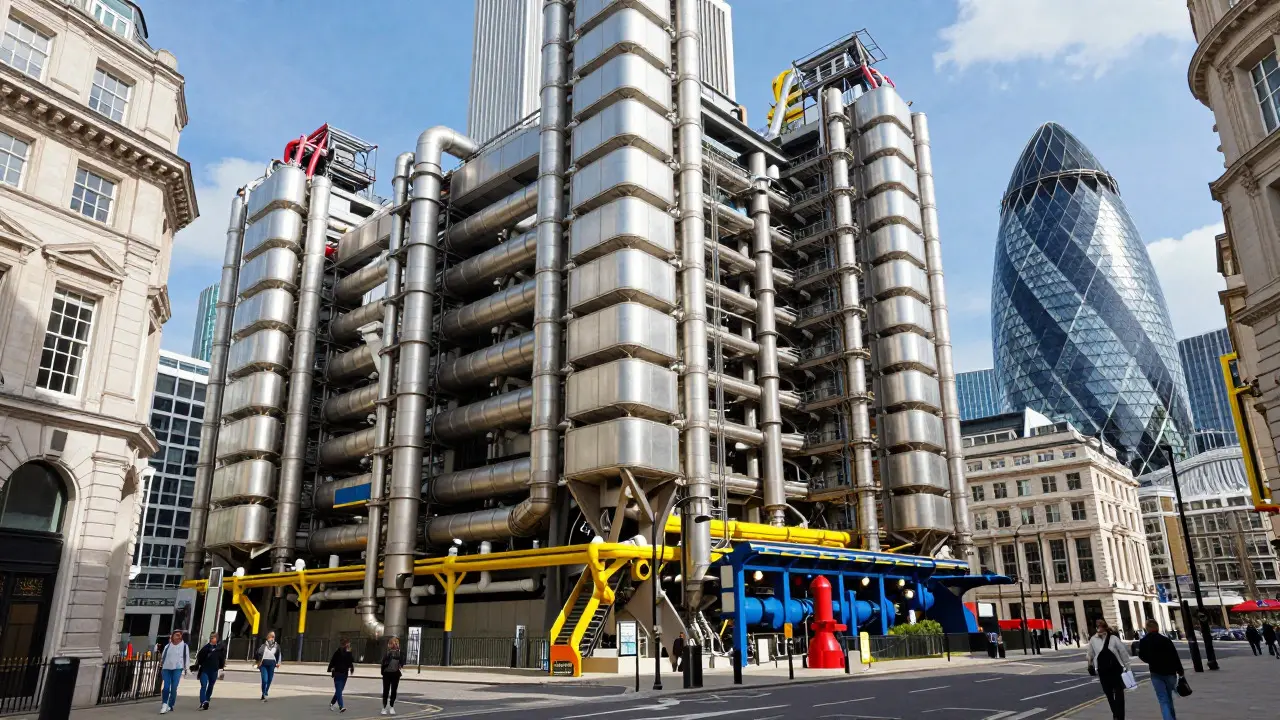
- Barbican Centre (Contextual Note): Strictly speaking, the Barbican is Brutalist, but its success proved that large-scale public architecture could work. Postmodernists looked at the Barbican and asked: "What if we added more human scale?" This led to projects like the Lloyd's Building, a headquarters for Lloyd's of London designed by Richard Rogers which exposed its structural systems on the exterior.
- Lloyd's Building: This is perhaps the most famous example. Completed in 1986, it looks like a machine turned inside out. Pipes, lifts, and stairs are visible on the outside. It rejects the hidden structure of Modernism. It’s bright, it’s industrial, and it’s incredibly functional. Critics called it a "space-age cathedral," while supporters argued it was the first truly honest office building in decades.
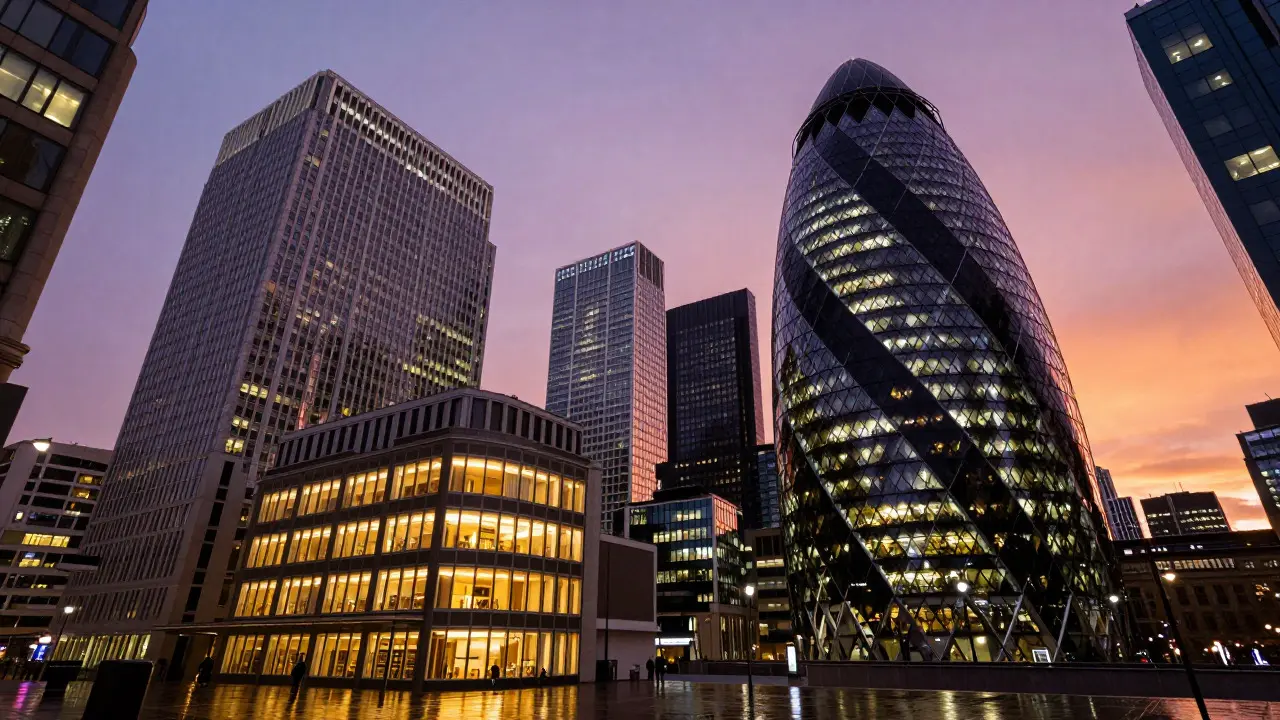
Another key player is the Gherkin, 30 St Mary Axe, designed by Norman Foster, which technically bridges the gap between High-Tech and early contemporary styles but emerged from the same desire to break rigid rectangular forms. Though often associated with the 2000s, its design process began in the mid-90s, reflecting the lingering influence of postmodern experimentation with form.
The Great Debates: Kitsch vs. Innovation
No discussion of Postmodernism in London is complete without the arguments. When these buildings first went up, they didn’t win universal praise. The debate usually centers on two main points: authenticity and permanence.
The Purist Critique: Traditionalists and Modernist purists argued that Postmodernism was dishonest. Using classical elements like arches and columns on a steel frame was seen as "lying" about the material. If a column doesn’t support weight, why put it there? To them, it was superficial decoration masking a lack of structural integrity. They feared that if you let architects play with history, the quality of construction would drop, leading to cheap imitations.
The Humanist Defense: On the other side, defenders argued that Modernism had failed the public. People didn’t care about the purity of the structure; they cared about how the building felt. A facade with a cornice or a decorative pattern created a sense of place. It connected the new to the old. For many Londoners, the colorful and varied streetscapes of the 1980s and 90s felt more welcoming than the grey monotony of the 1960s.
There was also a political angle. The Thatcher era encouraged private development and deregulation. Postmodern architecture fit perfectly with this climate. It was bold, commercial, and visually striking-perfect for attracting international investment. Critics accused architects of serving bankers rather than communities, using flashy designs to mask the displacement of working-class neighborhoods in areas like Docklands.
Impact on Urban Planning and Neighborhoods
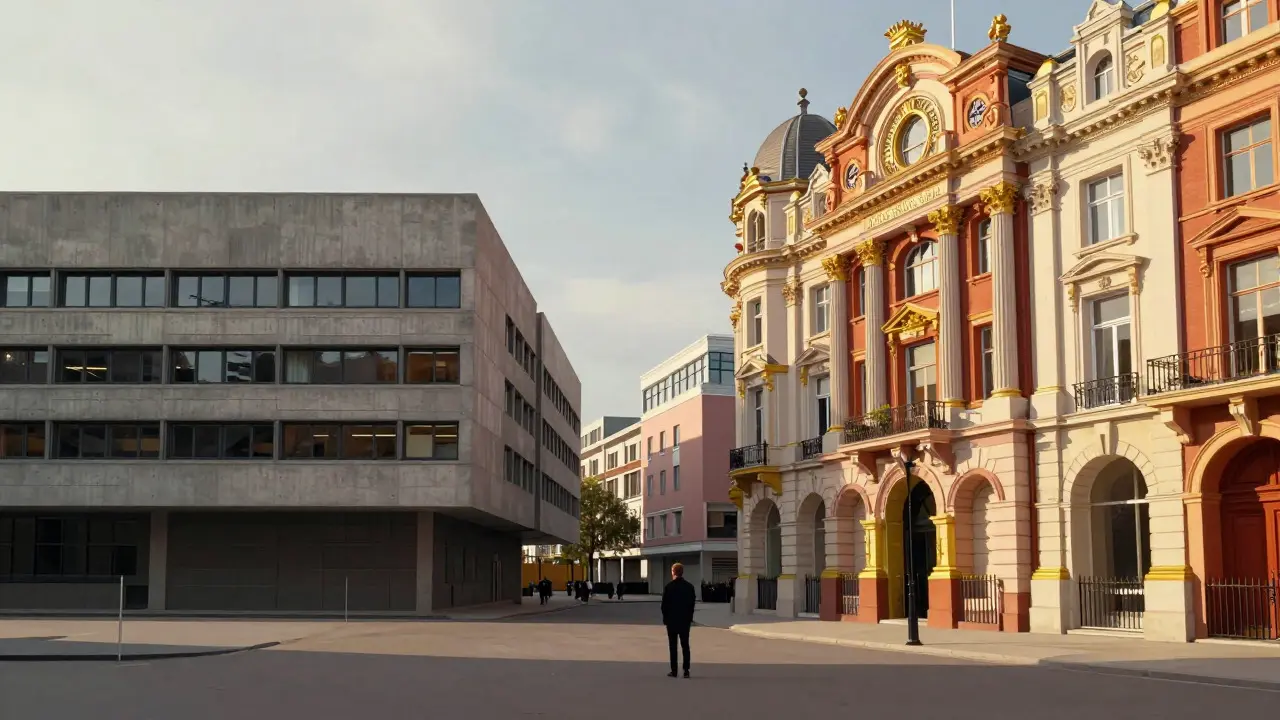
The legacy of Postmodernism in London goes beyond individual buildings. It changed how we plan cities. Before the 1980s, large developments were often isolated islands. Postmodern projects, especially in the City and Canary Wharf, introduced the concept of the "mixed-use podium." These ground-floor levels were designed to be active with shops, cafes, and public spaces, blurring the line between the private office tower and the public street.
This approach influenced subsequent planning policies. Today, when you see a new development in Shoreditch or King’s Cross, you’re seeing the long-term effect of Postmodern ideas. The requirement for active frontages, pedestrian-friendly scales, and visual variety in new builds can be traced back to the lessons learned during the Postmodern period. It taught planners that architecture needs to talk to the street, not just the sky.
| Feature | Modernism (1950s-1970s) | Postmodernism (1980s-1990s) |
|---|---|---|
| Ornamentation | None ("Form follows function") | High (Historical references, color, texture) |
| Material Honesty | Exposed concrete/steel | Often concealed or stylized materials |
| Street Interface | Often blank walls, low interaction | Active frontages, engagement with pedestrians |
| Symbolism | Universal, abstract | Local, contextual, ironic |
| Key London Example | Barbican Estate | Lloyd's Building |
Legacy and Current Relevance
Is Postmodernism dead? Not exactly. It evolved. Today, we see echoes of it in the playful facades of residential towers in Stratford and the mixed-material cladding of new commercial hubs. The strict boundaries between "high art" and "commercial design" that Postmodernism blurred have never been re-established. Architects now freely mix historical motifs with digital fabrication techniques.
For visitors and residents alike, understanding this era helps you read the city better. When you see a building that looks a bit odd, a bit too colorful, or a bit too busy, it’s likely a Postmodern piece. It’s a reminder that London is not a museum of perfect symmetry. It’s a living, arguing, evolving entity that has tried every trick in the book to figure out how to live in the future. And sometimes, that means looking backward to move forward.
Frequently Asked Questions
What is the most famous Postmodern building in London?
The Lloyd's Building is widely considered the most iconic example. Designed by Richard Rogers and completed in 1986, it exposes its mechanical systems on the exterior, challenging traditional notions of beauty and function. Its bright colors and complex geometry make it instantly recognizable.
How does Postmodern Architecture differ from Brutalism?
Brutalism focuses on raw concrete and monolithic forms, emphasizing strength and durability. Postmodernism, in contrast, embraces diversity, color, and historical reference. While Brutalism says "this is what the building is," Postmodernism says "this is how the building feels." Brutalism is often austere; Postmodernism is often playful or ironic.
Are Postmodern buildings still popular today?
Pure Postmodernism is less common now, but its principles have become mainstream. Modern architects frequently use mixed materials, varied textures, and contextual design elements that were pioneered during the Postmodern era. The rejection of strict Minimalism has made way for a more eclectic approach in contemporary London architecture.
Who were the key architects of the Postmodern movement in London?
Richard Rogers and Norman Foster are the most prominent figures, though their work often blends High-Tech and Postmodern elements. Other significant contributors include firms involved in the redevelopment of the City of London and Canary Wharf, who applied Postmodern strategies to large-scale commercial projects to create vibrant street-level environments.
Why was Postmodernism controversial in the 1980s?
It was controversial because it challenged the established hierarchy of architectural values. Purists viewed it as superficial and dishonest, while progressives saw it as a necessary correction to the alienating nature of Modernism. Additionally, its association with the financial boom of the Thatcher era led some critics to view it as an aesthetic tool for capitalism rather than genuine artistic innovation.
What is the most famous Postmodern building in London?
The Lloyd's Building is widely considered the most iconic example. Designed by Richard Rogers and completed in 1986, it exposes its mechanical systems on the exterior, challenging traditional notions of beauty and function. Its bright colors and complex geometry make it instantly recognizable.
How does Postmodern Architecture differ from Brutalism?
Brutalism focuses on raw concrete and monolithic forms, emphasizing strength and durability. Postmodernism, in contrast, embraces diversity, color, and historical reference. While Brutalism says "this is what the building is," Postmodernism says "this is how the building feels." Brutalism is often austere; Postmodernism is often playful or ironic.
Are Postmodern buildings still popular today?
Pure Postmodernism is less common now, but its principles have become mainstream. Modern architects frequently use mixed materials, varied textures, and contextual design elements that were pioneered during the Postmodern era. The rejection of strict Minimalism has made way for a more eclectic approach in contemporary London architecture.
Who were the key architects of the Postmodern movement in London?
Richard Rogers and Norman Foster are the most prominent figures, though their work often blends High-Tech and Postmodern elements. Other significant contributors include firms involved in the redevelopment of the City of London and Canary Wharf, who applied Postmodern strategies to large-scale commercial projects to create vibrant street-level environments.
Why was Postmodernism controversial in the 1980s?
It was controversial because it challenged the established hierarchy of architectural values. Purists viewed it as superficial and dishonest, while progressives saw it as a necessary correction to the alienating nature of Modernism. Additionally, its association with the financial boom of the Thatcher era led some critics to view it as an aesthetic tool for capitalism rather than genuine artistic innovation.